Last Updated May 26, 2026
The 4 Waveforms in RifePlayer: Sine, Square, Triangle & Sawtooth
by RifePlayer Team
05 Mins read
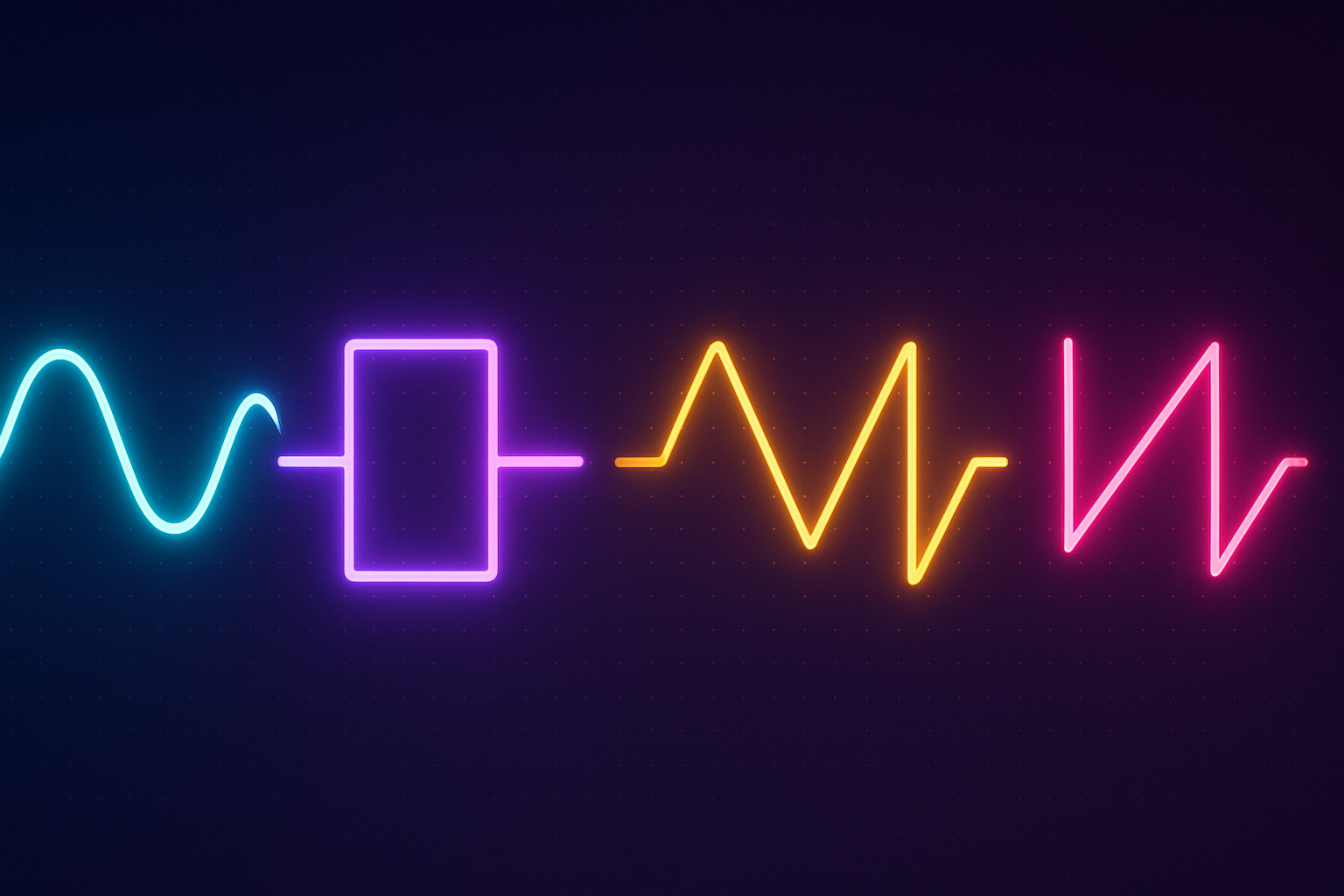
When you open RifePlayer and start a session, the app is doing something deceptively simple: it’s generating an audio signal at a specific frequency and playing it through your speakers or headphones. But there’s a choice hiding inside that signal — what shape should the wave have?
RifePlayer gives you four options: sine, square, triangle, and sawtooth. They share a frequency, but they sound — and behave — very differently. This guide explains what each one is, why the shape matters, and which to reach for first.
Why the waveform matters
Frequency is “how often” a wave repeats. Waveform is “what the wave looks like” each time it repeats. A 1,000 Hz sine and a 1,000 Hz square cycle at exactly the same rate, but the square wave packs in extra energy at higher frequencies called harmonics.
Harmonics are integer multiples of the base frequency. A 1,000 Hz signal can have content at 2,000 Hz, 3,000 Hz, 5,000 Hz, and so on. Different waveforms produce different harmonic patterns, which is the whole reason a clarinet and a violin playing the same note sound nothing alike.
In Rife work, harmonics are the difference between a “pure” tone and a “rich” tone that can resonate with more than one target frequency at once. That’s why RifePlayer lets you choose.
1. Sine wave — the pure tone
A sine wave is the simplest possible periodic signal. It contains exactly one frequency and no harmonics at all. It’s the cleanest, smoothest sound your ear can hear — closer to a tuning fork or a steady whistle than to a musical instrument.
What it sounds like: soft, hollow, mellow. No edge.
Pros
- Mathematically pure — the signal at the frequency dial is exactly what comes out.
- Lowest perceived loudness for a given amplitude; comfortable for long sessions.
- The waveform Royal Rife himself used in his original experiments. Pure sine is the “control” of the waveform world.
Cons
- No harmonics means if your target frequency is even slightly off, there’s nothing else nearby to help.
- Can feel “thin” through small speakers — bass-heavy frequencies often need physical headphones or a subwoofer to come through at all.
When to use sine: when you trust the frequency you’re playing, want the gentlest possible session, or are stacking many frequencies at once and want to keep the mix uncluttered.
2. Square wave — RifePlayer’s default
A square wave snaps instantly between two values: full positive, then full negative, with no in-between. That sharp on/off shape is mathematically equivalent to a sine wave at the base frequency plus every odd harmonic above it (3×, 5×, 7×, 9×, …) at progressively lower amplitudes.
That harmonic stack is exactly why most Rife practitioners and machine builders recommend square waves. A 1,000 Hz square delivers usable signal at 1,000, 3,000, 5,000, 7,000 Hz and beyond all at once. If the “correct” target frequency for a given purpose is a little off from your fundamental, the harmonics give you a much wider net.
What it sounds like: buzzy, hollow, organ-like. Reminiscent of an 8-bit game console.
Pros
- Rich in odd harmonics — covers many resonant targets simultaneously.
- Highest signal energy of the four shapes for a given amplitude, so the tone “carries” further through the body’s tissues.
- The traditional Rife waveform recommendation and RifePlayer’s default for that reason.
Cons
- The buzzy character can be fatiguing over long sessions, especially through earbuds.
- The high-harmonic energy can sound harsh on bright speakers — try lowering the volume rather than reaching for tone controls.
When to use square: as your starting point. If you don’t have a reason to choose another shape, leave it on square.
3. Triangle wave — the middle ground
A triangle wave rises in a straight line, hits the top, falls in a straight line, and repeats. Like the square wave, it contains only odd harmonics — but those harmonics fall off in amplitude much faster (at roughly −12 dB per octave instead of the square’s −6 dB).
The result is a tone that has harmonic content, but a lot less of it than a square. It sits between sine (none) and square (lots) on the harmonic spectrum.
What it sounds like: warm, soft, slightly hollow. Mellower than a square, fuller than a sine.
Pros
- Some harmonic coverage without the buzz of a square.
- Easier on the ears for long sessions than square.
- Useful when you want a more “musical” feel — pairs well with binaural beats or layered ambient audio.
Cons
- Less reach into the harmonic series than a square — not the first choice if you specifically want broad harmonic targeting.
- Can sound similar to a sine wave through small speakers, where the upper harmonics get rolled off anyway.
When to use triangle: when a square feels too aggressive but a pure sine feels too thin. A practical “long session” waveform.
4. Sawtooth wave — the brightest
A sawtooth wave climbs in a straight line and then drops vertically back to the bottom (or the reverse), making the asymmetric tooth shape it’s named after. Unlike the square and triangle, the sawtooth contains both odd and even harmonics, with energy falling off at −6 dB per octave.
That makes the sawtooth the richest of the four shapes — every integer multiple of the base frequency is in there. It’s the wave of choice in synthesizers when you want a sound that can “cut through” a mix.
What it sounds like: bright, brassy, aggressive. Closer to a string section played hard than to a soft drone.
Pros
- Maximum harmonic density — every harmonic is present, both odd and even.
- The most timbrally “alive” of the four shapes.
- Useful for experimentation when you want to maximize the chance of brushing past a useful resonance.
Cons
- Most fatiguing to listen to for long periods.
- The brightest harmonic content can be unpleasant through tweeters at higher volumes.
- Not a traditional Rife recommendation — square is the historical standard.
When to use sawtooth: sparingly, and for experimentation. If you find that square and triangle aren’t producing the response you expected, a sawtooth gives you the widest possible harmonic spread to test against.
Quick reference
| Waveform | Harmonics | Sound | Best for |
|---|---|---|---|
| Sine | None | Pure, soft, hollow | Long, gentle sessions; layered mixes |
| Square | Odd, slow falloff | Buzzy, hollow, rich | Default Rife sessions |
| Triangle | Odd, fast falloff | Warm, mellow | Long sessions where square feels harsh |
| Sawtooth | Odd + even | Bright, brassy | Experimentation, max harmonic spread |
A note on what reaches your tissues
There’s a long-running debate in the Rife community about what happens after a waveform leaves the speaker. The body is electrically resistive and acoustically lossy — it tends to smooth sharp edges back toward a rounder shape. Some practitioners argue that even a square wave is effectively a sine wave by the time it reaches deep tissue, with the harmonics riding along as transient energy.
The practical takeaway: don’t obsess over the waveform. Pick one that sounds tolerable, run consistent sessions, and adjust if you’re not seeing the response you want. RifePlayer makes it a single tap to switch — try a few and trust your own experience over forum dogma.
How to change the waveform in RifePlayer
Open any program, then look for the waveform selector in the session controls. Tap to cycle through sine → square → triangle → sawtooth. Your choice is saved per session, so you can experiment freely without losing your default.
If you’ve never changed it, you’ve been using square — and that’s a reasonable place to stay. But if a long session leaves your ears feeling tired, or if you want to hear what a “pure” Rife frequency sounds like, the other three are one tap away.
This article is for educational purposes only and is not medical advice. RifePlayer is a wellness tool, not a treatment for any disease. Consult a qualified healthcare provider for any medical concerns.
Related Guides
- The Complete Rife Machine Guide — plasma, contact, and software devices
- What Is a Rife Machine? — Rife definition and how the therapy works
- How Much Do Rife Machines Cost? — 2026 buying guide with real prices
- Understanding Rife Frequencies — the science behind the numbers
- Browse the Rife Frequency Database — thousands of programs, free
Read More Articles

Ready to start your healing journey?
Experience the power of rife frequency therapy with RifePlayer - the easiest way to use rife frequencies for your wellness.